An Answer for
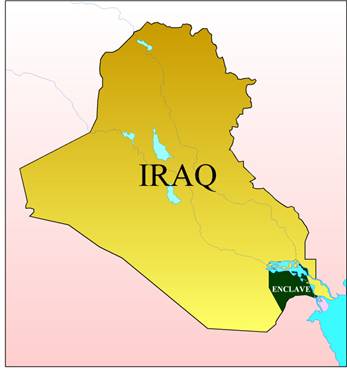
The Enclave Solution
David Sinclair
Revision after posting at eurotrib.com and dailykos.com
Most suggestions for what America should do in Iraq have ignored the
causes for the problems and the demands of the Iraqis, focusing instead on only
the single dimension of how many American troops should be in Iraq: more, a
temporary surge, the same, less, or none.
The geography of the country provides a different type of solution that
might be acceptable to both Republicans and Democrats, should be welcomed by
the military, satisfies the Iraqi people and leaders, and lessens the risk of
civil and regional war.
- Remove American
troops from Iraqi cities, as requested by the Iraqi people, by Iraqi leaders,
by the American military, and now by Donald Rumsfeld. Our soldiers will no
longer have the horrendous task of trying to police a people they do not
know or understand. The Iraqi people will no longer wake up to the sight
of an occupying infidel army on their street.
- Stop the
sabotage and theft of Iraqi oil. Oil is the key to
- Under strict
international scrutiny, all profits are returned to the Iraqi people,
paying directly for the army and distributing at least part of the rest equally
to the 275 constituencies of proportionally elected members of the Iraqi Council
of Representatives. Therefore, the oil profits and the resulting power are
partitioned fairly among the competing factions (to help avoid civil war) while
keeping the country together (to help avoid regional war).
- Within the high
security of the Enclave, workers from Coalition countries will repair and
modernize oil production. Natural gas, a by-product of oil production,
will once again be readily available for Iraqi domestic use. Oil is exported
directly from the Enclave, free from sabotage and theft. Record exports
together with current high prices will provide profits that when poured
back into the country will promote reconstruction and provide a
satisfactory standard of living for the Iraqis.
An Answer for
The midterm election has brought
a call for a solution to the problems
The experts have become very skilled at criticizing positions other than their own along this continuum, but they seem to have become blind to solutions that lie off of the line. I believe there are better solutions, but we need to step back and take a broader view if we are to see them. In this case, a solution does not need to be out of the two-dimensional envelope in order to be new: it only has to be off of the one-dimensional line.
This paper describes one such
program: the Enclave Solution. It is not staying the course, but it leaves
The Enclave Solution is a comprehensive program. Some specific actions have been recommended earlier, but the program as a whole is different from anything I have seen being proposed. I hope it will receive a proper consideration, first, as an example that staying and leaving are not the only two options and, second, perhaps as a guide to what really should be done.
A. Requirements
1. Political.
The most important criterion for a solution about what
2. Military. It must stop improper use of American soldiers. Presently they are being made to be policemen in a place where they do not speak the language, do not understand the culture, and where their very presence as foreign occupiers is an incitement to most of the people. Every cop on the block knows how important it is to know the people, and to command their respect. American troops should be asked to do jobs for which they are suited, capitalizing on their abilities, training, and equipment.
3. Peace in and around
4. Acceptable to Iraqis. To the average Iraqi, the face of the American soldier outside the door is not that of a liberator; it is the face of an invader. We are an occupying army, and like all occupying armies throughout history, we are hated. An acceptable solution must remove this most critical source of pain, fear, and subjugation from the Iraqi people. It must consider their other grievances including the widespread lack of electricity, natural gas, gasoline, and water. It must also attend to what the elected Iraqi leaders are demanding.
5. Culturally appropriate. The solution must promote a better
means for influencing behavior. The
administration has used in
6. Economically successful. The solution should bring Iraqi oil flowing properly
to markets. Iraqis are addicted to
petrodollars. Long term plans might try
to change the situation. But if we want a solution that is going to succeed now,
the solution must satisfy the dependence and make proper use of it.
B. The Enclave Solution
Prime Minister Maliki said he
told President Bush that Coalition forces must be removed from the Iraqi cities. The Health Minister of
The Administration should
announce that it intends complying with the wishes of the Iraqi leaders and the
Iraqi people. American soldiers will be
redeployed out of the urban areas beginning at a specified early date. This action will be celebrated in
As many troops as possible should
be redeployed to an “Enclave” in southeast
 The Enclave contains about 2% of the total
area of
The Enclave contains about 2% of the total
area of
Redeployment begins almost immediately, removing soldiers from outlying urban posts into the Enclave. The pace is initially slow for each post, but then when the number of soldiers is approaching the critical limit needed to defend that post, there will be a final move when all of the remaining soldiers are redeployed at one time.
The primary mission of the soldiers in the Enclave is simply to defend the Enclave, the oil fields, and the oil production machinery from attempts by sectarian insurgents to take it over for the exclusive benefit of one of the three factions, or by terrorists to destroy production capacity. The methods of the insurgents and terrorists often had an advantage over ours in urban guerrilla warfare. As demonstrated in Desert Storm and the opening phase of the current Iraqi war, however, the high technology of the American military gives us a strong advantage when fighting in open desert country.
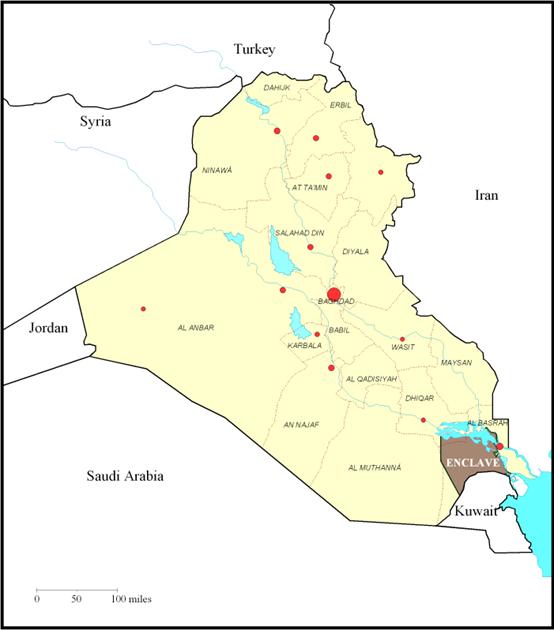
Fig. 1: The Enclave
|
|
|
|
American forces would be redeployed away from
Another mission is to protect the
Iraqi oil fields from foreign attacks. It
is possible that in a civil war,
There already appear to be plans for about 5 “enduring” American airbases, although solid information is scarce. None are in the Enclave area but instead most are close to cities. The only thing different about having one in the Enclave is that it would protect the oil fields from attack while being a more secure location for the troops.
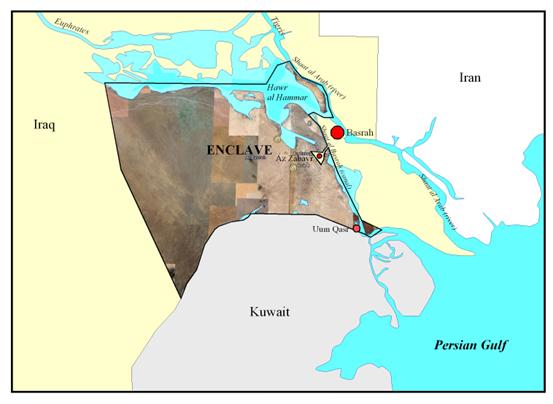
Fig. 2. Close up of the Enclave
The details in the Enclave are from Google
Earth photos. Smoke plumes from the Rumaila oil field can be seen directly
below the “ENCLAVE” label. (This newer
Jan. 2007 Google has a white cloudy rectangle covering the area above Az
Zabayr where the primary British base now is located.)
1. Geography
Most of the area of the Enclave
is sparsely populated (Figures 2 and 3). There is one town, the deep water
The borders of the Enclave are relatively
easy to defend. The southern border of the
Enclave is
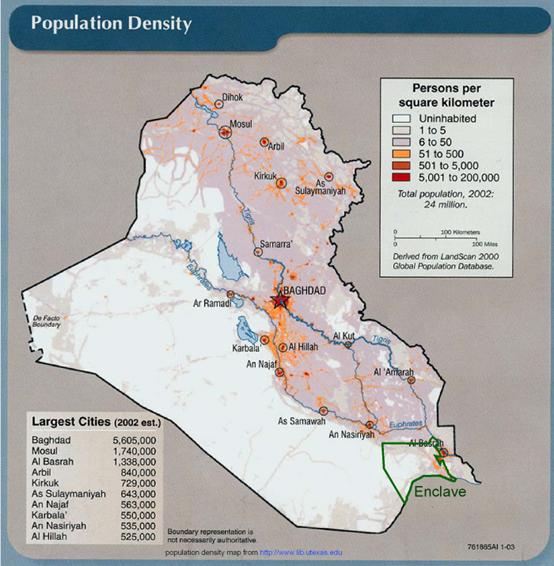
Fig. 3: Population density
Only a few thousand Iraqi currently live in the Enclave area. Most is
uninhabited desert. The data here are from 2000; much of the
population in the eastern part of the Enclave has since left. Google Earth
shows most buildings in the Enclave area nearest to Basrah having been
destroyed. Hawr al Hammar lake on the northern border of the Enclave had been
drained in 2000.
Despite its desolation, the
Enclave has a rather good transportation infrastructure. Several small airports
as well as
2. Oil fields
The Enclave contains the
supergiant Rumaila oil field, plus the Rachi, Suba, Ratawi, Luhais, Tuba, Nahrumr
(Majr Omar),
Together these ten fields have
71% of the total Iraqi available oil production (1,800,000 of 2,520,000 barrels
per day) and also 71% of the known reserves (61,360,000,000 of 86,630,000,000
barrels). The only major field not included is the
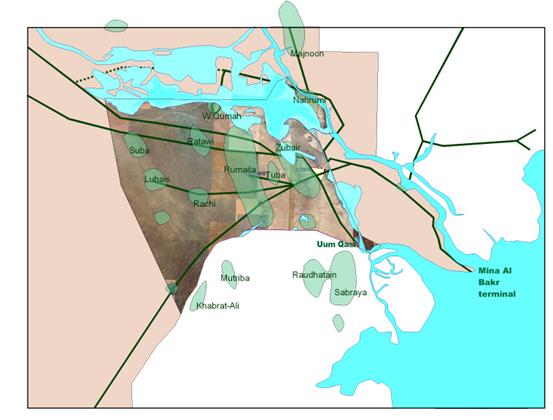
Fig. 4: Oil fields and pipelines on aerial view of the Enclave area
The Enclave (yellow border) contains 71% of Iraqi oil production and reserves. The oil fields are shown in green (white labels) and known pipelines as green lines.
There are several routes for
export of Iraqi oil but all were closed during the period of sanctions except
the one north through
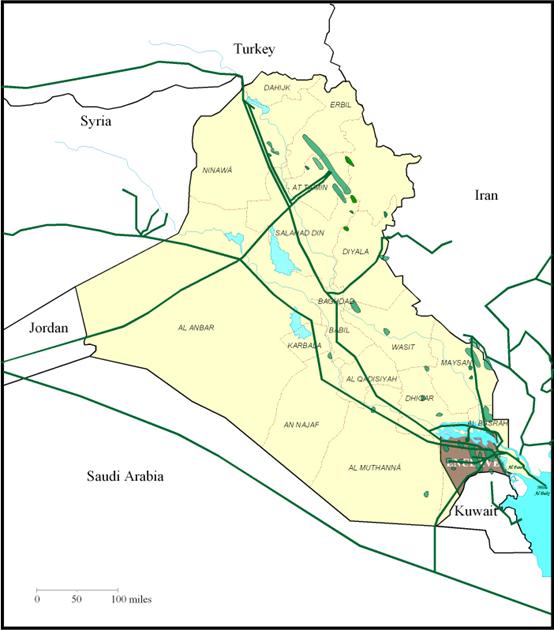
Fig. 5: Oil fields and
pipelines for Iraq
3. Supply lines
A basic military rule over the
ages has been that the advantage lies to the opponent with the shorter, less
vulnerable supply lines. American troops
in
Deployment to the Enclave,
however, reverses the situation, giving American troops shorter, more secure
supply lines than the enemy enjoys. Umm Qasr is a secure deep water port within
the Enclave. Provided we maintain naval
control over the
One must also consider worst
cases. There is always the possibility
that the balance of power will turn against us in the future. The Enclave situated next to the
C. Three countries in one
The Newsweek correspondent in Baghdad, Michael Hastings, attended
Bush’s recent visit to Vietnam, and filed a very perceptive article,
"Clean Slate", about the differences between Iraq and Vietnam; differences he says that will probably
prevent an easy American withdrawal this time.
The first difference, of course, was the oil, providing Iraqis with
something very valuable to fight over.
The second difference is that
Historically, there was no
Reports vary as to the amount of animosity between the factions prior to the present war. Some Iraqis talked about living side by side with the other faction, even intermarrying with them. On the other hand, the Sunni domination of the Shia during the Saddam period and the atrocities committed against the Shia created hostility on the part of the Shia and, worse, created in the Sunni a feeling that they were superior and destined to rule the Shia. What has happened between the factions since, during the occupation, has assured that there is great hostility between them today.
The dependence upon petrodollars
supports the hostility. If
Traditionally, the person in
Not surprising, decisions about the division of oil revenues were of foremost concern in the formation of a central government but could not be resolved. The constitution states that the current oil production is the property of the Iraqi people, as a whole, but then there are statements implying that new oil deposits developed in the future are not general property but rather belong to the individual province.
This is a pivotal period in Iraqi history. The Constitution may well be just a piece of paper, and actually possession may in fact confer ownership. If one faction does manage to secure the oil for itself alone, their people for many generations will have lives of leisure, opulence, and power, while the other two factions will fall to poverty and subservience for as long as the oil lasts. Winner takes all. With a prize like that, faction leaders can justify a bit of bloodshed today.
Of course, it would be nice if all three factions shared the oil, the profits from the oil, and the power of the central government, and the might of the Iraqi army. Realistically, however, none of them trusts the others to play fair. The stakes are just too high.
No Sunni will allow himself to be ruled by a Shiite. No Shiite will ever again submit to the leadership of a Sunni. And no Kurd will allow either of the other two factions to control him. Each is willing to fight a civil war to prevent being dominated by another faction.
The only way to prevent full scale civil war, therefore, is to partition the power.
On the other hand, at the
beginning of the invasion, the American administration promised the world, and
particularly its NATO ally,
Confederation has been seen as
the solution to this dilemma. There are,
however, two problems. Confederation
requires a central government that is independent of the factions and
sufficiently powerful to avoid being taking over by any one faction. Power in
The second problem is that confederation divides power geographically. Provinces are geographical creations with areas and borders. The factions are not, however, perfectly divided geographically. Some provinces do contain mainly one faction, but other provinces are mixed. No Sunni wants to have a Shia provincial governor above him.
D. Power partition in a unified Iraq
The Enclave Solution is to use
the dependence upon petrodollars to partition the power in
All profits from the sale of
Iraqi oil are returned to the Iraqi people.
Use whatever accounting means and/or controls are needed to assure that
The most common criticism of the
Enclave Solution I have gotten has been that the
Finally, all this bickering about
whether
An important and distinctive
feature of the solution is that the profits are not given just to the executive
central government of
The traditional means of
establishing power in
Power in
Furthermore, the flow of
petrodollars is not restricted by geographical borders. The petrodollars from the Sunni leader will
flow to Sunnis throughout the country. (This
might be compared to the money from General Motors flowing to workers
throughout
Although the power in
E. Oil production
The
Many Europeans have assumed that
· First, protecting the oil was generally handed over to the British. Probably the justification was that the British were centered in Basrah province which includes most of the oil production.
· The British military outsourced the job to a British security company, called Olive Group.
· Olive Group in 2004 handed the work over to a paramilitary group called the Oil Protection Force (OPF) under the command of Lt Col Mazin Yousif, formerly in Saddam Hussein’s army. He hired 4500 men, most of whom had served in Saddam’s army, too.
· The part the Americans did not give to the British, they outsourced to a South African company, Erinys International, and then it hired paramilitary Iraqis to protect the oil facilities.
It is ironic that
The Shiites noticed, however, as
shown in a report on
"This must be a joke!" snapped
Mazin Yousif, peering out from the back seat of his SUV at a sandbagged OPF
checkpoint. "Impossible!" Strange new faces were appearing at the
checkpoints. They were the bearded members of local Shiite parties and their
violent militias. [Yousif’s] oil army was being infiltrated. In places like
The sectarian war over the oil has already started. It started the minute the British handed responsibility over to Sunni paramilitaries. There is a disturbing parallel here with the events prior to 1932 when the British, primarily in Basrah, handed over responsibility for the country to the Sunnis.
Protecting the oil is difficult,
with over 8500 km of pipeline, most of it above ground and exposed. Even with
that considered, the paramilitary forces have done a surprisingly poor
job. The insurgents seem to know exactly
the times and places where they can attack in order to hurt production.
Meanwhile, despite the constitution saying the oil belongs to all Iraqis, the Kurds are already talking to international oil companies about production in Kurdish territory. There are rumors that Shia leaders are doing the same. And Sunni paramilitary organizations have control of the oil fields. The Americans may not have been interested in the oil, but the Iraqi factions know the key for their success.
A study was conducted by the
Office of the Special Inspector General for Iraq Reconstruction. The Unclassified Summary of SIGIR’s Review of
Efforts to Increase
“
The report concludes:
The Iraqi government has much to do if it is
to implement
In other words, 1) the oil
production must be protected; 2) the Iraqi central government cannot currently protect
the oil; 3) hiring sectarian Iraqi paramilitaries has not worked. The obvious conclusion is that
Restoring oil production is the key to restoring the country and its economy.
Protecting the oil is one job the American soldiers could do very well. It does not require speaking the language or understanding the culture.
The OPF paramilitary soldiers now being paid to guard the southern oil fields would be better at patrolling the urban areas, especially Sunni areas, than we are, and might well be reassigned to that task. Perhaps these largely secular soldiers might be good working in mixed neighborhoods, too.
We cannot hope to provide perfect
security to all of the oil fields and pipelines across
A military doctor serving in
The same attitude can be seen in some of the objection of the American military leaders to Bush’s proposed surge in troop strength. Sending in additional soldiers to achieve a specific goal – to move a mountain – would be fine. But just sending more in to do the same police work is not going to solve the problem.
In contrast, establishing and securing the Enclave is exactly the type of specific project, with a concrete goal, that the soldiers want. Furthermore, the goals are more meaningful that moving a mountain.
The military understands that if you
meet a formidable opponent, you do not spread your forces everywhere – and
succeed no where – but instead you concentrate on the most critical target. The
same is true when providing the security necessary for reconstructing
Redeployment to the Enclave would raise this one area above the confidence threshold. The oil fields in the Enclave would be sufficiently secure for real progress to be made in modernizing the facilities. It should be possible not only to restore pre-war production levels from the fields but to improve them to the extent that the total Iraqi exports are substantially increased.
The high world prices for
petroleum have allowed producers elsewhere to use what had been marginal
deposits. Oil sands can now be
economically utilized. Older wells can
be treated and brought back into production.
In
The increased petrodollars in
turn mean more money flowing into
F. Contracting
Some people claim for a solution
to be acceptable in
Fortunately, the Enclave Solution should be relatively good for contractors such as the affiliates of Halliburton. There is going to be a great need for reconstruction in the Enclave. Admittedly, there has been ample need for reconstruction before, but the work had to be done at high risk to the workmen. The difference now is that there will be ample security so the contractors can concentrate on their own work.
Under these conditions, it should
be possible to find workers from
It has been proposed that
Halliburton and other companies that have already profited from the war should
be barred from working in the Enclave. I
firmly believe that any previous corruption or improper procedures should be
prosecuted.. Setting up the rules for
operating the Enclave is not, however, a court.
Furthermore, any attempt to include punishment in the proposed solution
is a sure way to eliminate the solution from consideration by the current
government. Finding a way out of the
problems in
G. Proportional distribution of oil profits
In
section D on Power partition in a unified
A
primary goal for us in
Much
of the fighting between factions, however, is being caused by the reasonable
desire of each group to secure for itself as much oil, as much money, as much
military strength, as much political power as possible. Before the British left
The sectarian fighting can be reduced by removing these common prizes from competition. If no faction has a chance of capture the oil for itself alone, then there will be no sectarian fighting for the oil. That is the basic premise for the Enclave Solution.
Similarly, we should try to remove the other common prizes from sectarian competition. It is possible to use the profits from the oil to help do so. In general, we want to direct the revenue away from central features that could be captured by one faction or another. Instead, the final goal would be have the money flowing equally to each individual Iraqi.
The Baker-Hamilton Report mentions the idea of simply giving the petrodollars to the each person directly, but rejects it primarily because there is no structure for distributing the money that way. This is probably correct, but there are other ways to achieve proportional distribution of the oil profits.
The following plan is one of the possible methods for proportional distribution of the oil profits:
- As our troops are redeployed to the Enclave, we take responsibility for the selling of Iraqi oil in order to reduce corruption and sectarian profiteering. We assure, with independent auditing, that the money all goes to the Iraqi central government.
- We assume direct payment of all costs of the Iraqi army in order to lessen sectarian influences. Despite a surplus in the central government, many Iraqi soldiers fail to get paid which greatly increases the risk of their joining the insurgents and for soldiers having sectarian loyalty rather than supporting the central government. Making sure the Iraqi army is paid properly is particularly important if our soldiers become embedded as trainers into Iraqi army units, helping to assure that there are adequate resources for the training operations to be successful. The funds come from the oil profits and are subtracted from the money provided to the central government.
- A Representative Fund is established in order to reduce corruption in the legislative branch of the Iraqi government. The money is divided into 275 equal parts and paid to the constituencies of the 275 proportionally elected members of the Council of Representatives. The Representatives will manage the money for their constituencies. They are free to use the money in any way they choose; they do not even have to report to us how they used the money. The money for the Representative Fund comes from the oil profits, and thus is subtracted from the amount provided to the central government.
- The size of the Representative Fund is gradually increased. It may increase until it accounts for nearly all of the oil profits. The Representatives will to take over the responsibility for paying for the needs of their constituents such as for the police, the schools, and the health services. Normally legislative bodies, such as the American Congress, have responsibility for the budget, determining how the revenue of the government is spent. The difference with the Representative Fund is that each Representative individually gets to spend the money, without necessarily involving the executive branch. On the other hand, we may find that sectarian competition over control of the central government is not as bad as feared. This will happen, for example, if the central government acts in a fair manner toward all factions and gains their trust. If this happens, a larger percentage of the money can be left going to the central executive branch and less into the Representative Fund.
- The result is a redistribution
of some or perhaps all of the petrodollars and the resulting power among
the three factions. People will see
their Representative as the leader over them, the person to whom they owe
loyalty. If they want, Sunnis can
have only Sunni leaders in their chain of allegiance, Shiites can have
only Shia, and Kurds will have only Kurds.
On the other hand, voters supporting the Iraqi List, a secular
umbrella group that includes both Sunnis and Shiites, will have secular
leaders providing their payment. It also will provide separate funding for
the two Kurdish parties. The oil profits will be distributed as fairly as
is the proportional representation in the Council of Representatives. The
Representative Fund is, of course, equivalent to “pork” funding in
Currently there are complaints that the Shiite-headed executive branch is spending reconstruction funds only on projects helping Shiites. Prime Minister Nuri al-Maliki is being criticized for using his position as head of the central government for furthering the interests of the Shia at the expense of the Sunnis and Kurds. The Representative Fund would prevent this sectarian bias.
If the money were budgeted by voting decisions of the whole Council of Representatives, there is a danger that the Shia majority in the Council could fund only Shiite projects. Payment to the individual Representatives prevents the tyranny of the majority in the Council.
There is one bias imposed by this plan. It favors elected representatives over religious or military leaders or unelected party leaders. The money goes first to the leaders who are talkers, not to the fighters. It goes to those leaders who are sufficiently popular with the people to get their votes.
The importance of the Representatives, and the Council of Representatives, is increased at the expense of the executive central government. Control of the central government is no longer such an important prize for the winning faction.
Voting for Representatives, which appears to have been popular among the people, will be strongly supported. Voting will have powerful implications. The people are voting for who will get the money for them. If they think their current Representative is not using the money in their best interest, they can elect someone else.
As stated previously, this is
only one of various ways to distribute the oil revenues to the people. Others should be considered. One general concerning such plans is that we
must guard against the temptation for us to use the payments to micromanage
I believe these temptations should be resisted. I think we should avoid trying to say anything directly about how the Representatives should behave. We must let Iraqis tell us what is good for them.[1]
The Iraqi army is the only
exception in the proposed plan. It is
critical that the Iraqi army not come under sectarian control especially if our
soldiers are embedded within it. Our taking control of the payment for the
The decision to pay the money to the accounts of the Representatives rather than to the government is one of the most revolutionary features being proposed. In the time of a civil war, the other prize generally worth fighting over, besides the oil, is control of the central government. Giving the money to the Representatives reduces the power and influence of the central government greatly. It therefore, reduces the risk of fighting over control of the central government.
Going one step further, although this payment plan does distribute the money to the different factions, it also reduces the power of the factions per se. Representatives with their own money are less subservient to their religious leaders and party leaders at least during the periods between elections.
H. Comparison with Iraqi Study Group recommendations
The
Baker-Hamilton Report shows a clear vision of the severity of the situation in
Discussions with the neighboring countries are not only desirable but necessary if troops are being redeployed to the Enclave. In particular, the Iranians should be assured that the developments in the Enclave are not aimed at them but rather are in preparation for removing our soldiers from face to face contact with the Iraqi people, and switching their work to being the protection of the oil fields from sabotage or capture by one faction in a civil war.
Training Iraqis to handle
insurrectionists is a good idea if they are to be left with that task when our
troops are redeployed to the Enclave or brought home. There are, however, problems with embedding American
soldiers in Iraqi army units actually conducting operations against insurgents
if the fighting becomes sectarian. If a
unit containing only Sunnis begins firing against Kurds, the embedded trainers
may become involved in what is actually sectarian fighting. There is even the possibility that American
soldiers embedded with Sunni units would be fighting Americans in Shiite units.
Finally, there is the major danger that Iraqi army units could become hostile
and hold the embedded Americans as hostages.
Newsweek (
Training Iraqis should only be
done in locations in which we control security can prevent units from flipping.
We could fly them to
In addition, the Enclave could
make the difference in determining whether Iraqi soldiers and police are
successful in fighting insurgents. American
air support is of critical importance in the operations of the soldiers we
train when they are back in the field.
The Enclave will provide the most secure location in
I. Comparison with Rumsfeld’s memo
Two days before submitting his resignation, Secretary of Defense, Donald Rumsfeld sent a memo to Bush with his own list of recommendations. Many of them suffer from the problem of trying to tell the Iraqis what is good for them, rather than listening to what Iraqis say is good for them. Or worse, just doing what we think is good for them.
There is, however, overlap between some of his recommendations and those in the Enclave Solution:
· “Withdraw U.S. forces from vulnerable positions — cities, patrolling, etc. — and move U.S. forces to a Quick Reaction Force (QRF) status, operating from within Iraq and Kuwait, to be available when Iraqi security forces need assistance.”
The military in
·
“Conduct an accelerated draw-down of
He says we should go from 110 bases down 10-15 by next spring and only 5 bases by July, 2007. This is consistent with redeployment to the Enclave.
The major difference between these recommendations and the Enclave Solution is that Rumsfeld does not consider the situation from the Iraqi viewpoint. His recommendations are not aimed at reducing the sectarian fighting. He suggested we should get out of the cities because we are vulnerable there. That is true, and it is one reason for leaving. But the main reason is that our visible presence in the cities is the cause for most of hostility in general. From an Iraqi view, the insurgents are beloved Resistance Fighters, and we are the hated Occupying Forces. We cannot hope to predict how the Iraqis will behave if we cannot see the situation from their viewpoint.
Similarly, he recognizes the advantages to the American military to being on QRF status in secure bases, but he does not see how the establishment of a secure base, in the Enclave, could remove the most important stimulus for civil war – sectarian fighting for the oil production.
· “Provide money to key political and religious leaders (as Saddam Hussein did), to get them to help us get through this difficult period.”
This one is pleasantly surprising. It is, of course, very similar to my proposal
for a Representative Fund. It is
surprising, however, that Rumsfeld, in this instance at least, can see the
advantage to doing something in
The main difference is that Rumsfeld suggests
paying political and religious leaders, while the Representative Fund pays the
elected Representatives on behalf of their constituencies. Rumsfeld might have us paying Moqtada al Sadr
directly. It would probably work. In
·
“Initiate a reverse embeds program, like the
Korean Katusas, by putting one or more Iraqi soldiers with every
There are problems with this recommendation. It
ignores the power of sectarian loyalty in most Iraqis and the level of
hostility to
A major reason for the failure of the Administration’s approach has been the misconceived belief that our troops would be loved as liberators and, therefore, they could interact well on a daily basis with the Iraqi people. We should learn from this failure. Both the embedding program and this reverse embedding program increase contacts between our soldiers and the Iraqi soldiers. Iraqi soldiers are not that much different from the Iraqi people in general. The time has come to minimize all contact between our forces and the Iraqis. Training is still possible, but it should be done on our terms, and in effect in our culture within the Enclave.
J. Viewed by different groups.
In addition to being acceptable to both Republicans and Democrats, we need a solution that appeals to various other groups. A strong case for the Enclave Solution is produced by considering how it might appear to the different concerned parties.
1. The Iraqi people.
The main thing Iraqi civilians would see from the Enclave Solution is that the American soldiers are no longer in their faces:
- No more patrols on their streets by the occupying army.
- No more orders shouted in English.
- No more American prisons.
- No more humiliation from the Americans and their lack of understanding of the culture.
- No more infidel Americans walking through their holy places – in army boots.
- No more attacks aimed at Americans but hitting civilians.
- No more counterattacks aimed at insurgents but hitting civilians.
- Most Iraqis would say to both sides, “Fight each other if you must, but not in our yard!”
The Iraqis are mainly concerned
about getting the occupying army out of urban areas. They are not particularly
concerned where they, just as long as they go.
When Maliki demanded that we leave the cities, he probably assumed the
troops would be moved to bases located in remote areas of the country. There are advantages to the Iraqis of having
a strong American presence in
- Preventing invasion from neighboring countries. The
Iraqi army at present could not defend the country against take over by
- Keeping a lid on the civil war. Sectarian fighting may not stop, but American control of the air space and quick reaction forces could prevent large scale fighting with advanced weapons.
Historically, occupying armies in urban areas have stimulated much more hatred and resistance than the have foreign military bases in remote areas. Civilians are not bothered greatly by bases; if there are conflicts, they are almost all caused by interactions between the soldiers at the bases and the population. It is not the Cuban people who are complaining about Quantanamo.
The area of the Enclave is not a pleasant place to live. The Iraqi people would enjoy the idea that the Americans are going from Saddam’s palaces and the Green Zone in general to a harsh desert region.
The view of Iraqis to the next
step in the plan – having Americans protect and develop the southern Iraqi oil
fields – is completely dependent upon whether we can prove to them that we will
give all the profits back to the Iraqis.
This is not going to be easy, but it is of paramount importance that the
Iraqis believe this will happen from the beginning. There are initial steps that we can do, such
as placing in escrow an amount sufficient to cover quarterly profits.
Monitoring by the UN or some international organization that is trusted by the
Iraqis would help. This is the key
question for determining the success of the plan. The main criticism to the Enclave Solution
has been a knee-jerk denial that
If we are trusted, there are great benefits to the Iraqi people from American protection and development of the southern oil field:
- No more theft of oil at least from the 71% coming from the Enclave.
- No more sabotage of these facilities.
- Eliminating the possibility that any one faction will grab control of all of the oil and then using it to control the other factions.
- Reduction of the risk of civil war being triggered by sectarian fighting for the oil.
- Modernization of oil production facilities, in a manner preventing graft and corruption.
- Sufficient natural gas, gasoline, and other products of refining for all Iraqi requirements; elimination of the black markets.
- Greatly increased oil production, taking advantage of high prices, and providing ample funds for reconstruction.
The Iraqi people respect American technology. At the beginning of the war, they had a demonstration of its power to accomplish the tasks for which it is suited, including clearing deserts. So long as they are getting the profit, the Iraqis would be happy to have Americans using their advanced technology for protecting and developing the oil.
The Iraqi soldiers and their families would be pleased to get their salaries regularly. This increases the loyalty of the soldiers and decreases the risk to civilians.
All three factions would be pleased by the decreased risk of the army being taken over by one of them and used to suppress the other two. Everyone would be pleased by the lessening of chances of civil war with individual Army units flipping from national to sectarian loyalty.
The Iraqis in general would be pleased by a return of the familiar situation with petrodollars flowing down political lines to the people.
Finally, the partition of power will be pleasing to each faction. Sunnis will be happy that they are not controlled by a Shiite government; Shiites will be happy they are not again dominated by Sunni leaders; Kurds will be pleased that they have neither Sunnis nor Shiites above them.
2. The Iraqi leaders.
The Iraqi Representatives would be pleased by their increased power resulting from their administration of the payments to their constituencies. Since they are elected officials, they probably believe in democracy; consequently, they would be pleased by increase in power to elected leaders rather than religious or military leaders, even it they personally might be out of office at the time.
Maliki and others in the central government will lose power to the Representatives. Maliki probably would consider that a small price to pay to avoid civil war, to get the occupying armies out of the cities, and to free the oil fields from the Sunni paramilitaries.
Few if any of the faction leaders want a civil war. They are being forced to it by the fear that if they do not secure the resources and power for their faction, one of the other factions will get the oil and power in order to dominate the country. If you ask a Shiite leader does he really want the Sunnis reduced to severe poverty and subjugation by the Shiites, he would probably answer no in all honesty. But the more important thing for him is that he does not want his people reduced to poverty and subjugation by the Sunnis. The Sunnis did it to them before and he is sure they will try to do it again. Therefore, he has to grab the resource himself so the Sunnis will not get them.
The one exception is al
Qaeda. Its measure of success is the
number of new converts, and it increases with chaos. Osama bin Laden would probably like the
withdrawal of American forces from the cities for some reasons but not for
others. I believe he would be strongly
opposed to the establishment of a strong secure American presence in the
Enclave as this would help prevent the downfall of secure rule in united
3. The American soldiers.
It is easy to imagine how an
American soldier would view the Enclave Solution. First, they are going to get out of that
urban guerrilla warfare that Saddam threatened against them when they first
went in. Many will be going home, but
they are not going home in defeat. The
American military will still be the most powerful force in the region. They will have complete control of the air
over
True, the Enclave will be an unpleasant place to live. The work will be hard. Life will be far better than in cities. The soldiers did not enjoy being in the faces of the Iraqi civilians any better than the Iraqis enjoyed having them there. Life in the Enclave will be according to American standards. They can celebrate Christmas or Hanukkah openly. They can drink a beer in public without worry about the sensitivities of watching Iraqis.
They will be able to live in the Enclave with a high degree of security. There probably will still be fighting, but outside of the Enclave. They will be safe from the mortar fire that creates a nearly constant threat today.
Most important, our soldiers will be doing work that is consistent with their training, abilities, and equipment. There are clear goals:
- Protecting the enclave.
- Protecting the oil fields and equipment from theft, sabotage, and sectarian take over, so long as there is a threat of civil war.
- Increasing oil production and exports, in cooperation with contracting crews.
- Securing control of Iraqi air space.
- Mounting quick reaction force actions if needed.
- Maintaining international security in the center of
the
This is an important job, but one the American military can do.
4. Oil field workers.
The Enclave Solution should be popular with the construction crews repairing and developing the southern Iraqi oil fields. Currently there is great frustration. It is dangerous work even in completely peaceful surroundings, but it is nearly impossible with bombs and bullets surrounding them. Furthermore, the work they do one day may be blown up the next. There has been little or no progress over the course of the war.
In the Enclave, however, the crews will have the satisfaction of seeing their work bear fruit. Like the soldiers, they will be using the abilities for which they were trained. They will no longer be living in fear of being kidnapped, shot, or tortured. In addition to living with great security, the crews will also enjoy being able to live essentially within their own culture. The pay, although under tight control, will be consistent with the skill needed.
5. Consumers around the world.
Bringing the Enclave oil fields back into potential full production will help ease the current instability in the oil markets. Developing of marginal petroleum sources as well as alternative energy sources and conservation measures has now started on a large scale. It will continue provided there is no precipitous drop in oil prices. There is, however, a delay before they can have much impact. In the meantime, there is a period when critical demand is close to the available supply. As a result, the price of oil is susceptible to even small isolated factors around the world. The high instability, more than expected high prices, is a danger to economies around the world. Iraqi oil in the next few years could fill gap.
Consumers in Peking and in
K. An analogy
Imagine two possibilities.
1. You are in a room with three rowdy, hungry boys and one big cake. And you leave the room.
2. You are in a room with three rowdy, hungry boys and one big cake. You take the cake over into a corner (next to the door), and give each boy an equal slice, telling them they can have more in a while if they behave.
In the first case, there almost
certainly will be fighting over the cake.
That is
In the second case, the risk of the boys fighting against each other is minimized. Indeed they probably will behave. There remains some chance they all three will turn against us. We should be able to defend ourselves properly. If not, well, that is why we are next to the door.
L. Thinking like politicians
I have emphasized two points about how to find a novel and more effective solution:
1. We must stop focusing on the
single line of how many American soldiers should be in
2. We must consider different
viewpoints: that of the Iraqi people, the
But whose viewpoint is responsible for that one line along which thought has focused?
Think about it. Bush has been
saying “stay the course” with 140,000 soldiers in
This line is politicians’ line. The thing they can control most easily is the
number of soldiers they send to
The result, however, is that practically everyone else has had their thinking restricted to the dimension of American politicians. Frightening!
Furthermore, the nature of debate about the points on the politicians’ line has created a strange phenomenon: it has made compromise impossible. If you are buying a house with the seller asking $140,000, and you offer $100,000, you can expect the seller to offer $130,000; you say $110,000; and you settle at $120,000.
When Bush was confronted with what was generally agreed was a demand by the voters to start bringing the soldiers home, he did not make an offer of 130,000, thus sending 10,000 home. In fact, he went in the opposite direction to compromise; he suggested increasing the number of troops at least temporarily. He needed to do something – the voters had demanded it. The one thing he could do easily was to change the number of soldiers. He could not, however, make any reduction because that was in the direction of cut and run which he had condemned repeatedly. The only thing left for him to do was to increase the number.
The sad projection from this is that the number of troops will be progressively increased at least for the next two years. This really is the only option for change the Administration has so long as only solutions along the politicians’ line are considered.
M. Not inconsistent with a surge in troop strength
Simply an increase in the number of American soldiers is unlikely to improve the situation. If a patrol today had 14 soldiers, with the surge it would have 16. Or instead of 140 patrols, there could be 160. Even the administration admits that the increase will produce an increase in the amount of fighting, the number of civilians killed, and the number of Americans killed. The hoped that the increase would be temporary but reporters were unable to get an answer to how many years the increase would continue.
A temporary surge in troop
strength could, however, be consistent with the Enclave Solution. The transition period of redeployment to the
Enclave is a time of increased risk.
Similarly, Rumsfeld’s recommendations to “withdraw
N. Implications for al Qaeda
The major problem
The situation today is that al
Qaeda now is in
Osama bin Laden has outlined clearly their plans. First was the overthrowing of Saddam Hussein and his powerful restrictive secular rule.
Osama said, just before the
The Enclave Solution is contrary
to al Qaeda goals. First, redeployment
of our forces out of contact with civilians will stop the flow of al Qaeda
recruitment stories produced by the occupation. Second, the maintenance of a
strong American base in the Enclave will strengthen the secular governments.
From Osama perspective in the hills of
Another obstacle to the growth of
al Qaeda is the establishment of a strong economy in
0. Conclusions
I admit it: Bush bashing is
fun. I suspect Rush Limbaugh gets a lot
of fun out bashing liberals. It’s time, however, to move away from these fun
and games. The
We have to go off of that “politicians’ line” if we want to find a solution that will be acceptable to both Republicans and Democrats. We must consider the goals of the other side, and we must be considerate of the people having those goals.
So let me start by saying that if
I have insulted any conservative, neo-conservative, or Republican individuals
or groups by my wording or ideas, I apologize.
I have tried to see the situation from your point of view, among
others. I have tried to fashion a
proposal that satisfies what I have seen as your major concerns. In particular,
the Enclave Solution provides
There are many things that nearly
all of us can agree upon. I think we all
would like to have the number of troops in
To be honest, we Americans are more concerned about our own casualties than those of the Iraqis. (And the majority of Iraqis are not that unhappy at having Americans get killed.) Nevertheless, everyone agrees that full scale civil war should be avoided. We should try to understand the reasons for there being a civil war and then do whatever we can to remove those factors we can influence. Those prizes that the factions are fighting over should be removed from reach. The more valuable the prize, the more important it is to remove if from sectarian competition. The most valuable prize is the oil. If you project forward from the present situation, almost every path leads to full scale sectarian fighting over oil production. If this rivalry over oil is not settled, civil war is probably inevitable. There is a rather high probability that the civil war would expand to include neighboring countries.
The only way to prevent sectarian fighting over oil is to make it clearly impossible for any one faction to take the oil away from the other two and at the same time provide a believable promise to all three factions that they will get a fair share of the profits.
I agree that this should be a job
for a powerful international organization.
I think it makes a good argument for development of such a powerful
international organization. The United
Nations could be made into such a force.
There is only one reason why
It didn’t.
We did.
And here we are. With the risk of civil and regional war in our hands.
The Enclave Solution provides us with the means to decrease that risk in several ways:
- It removes the provocation to violence from an occupying army in urban areas. Insurgent attacks can no longer use the excuse that they were aimed at the Americans.
- It prevents oil and oil revenue from being the prize for winning a civil war.
- It secures payment of the Iraqi army while removing it from possible sectarian control.
- It partitions power so no Iraqi is governed by a leader from another faction.
- It maintains
- It retains a powerful American force in
- It improves the Iraqi economy and encourages reconstruction.
The most important part of the Enclave Solution is removal of American soldiers from the urban areas and contact with the Iraqi people, for the sake of both the Iraqis and the troops. The other parts of the Enclave Solution provide a comprehensive plan with advantages such as decreasing the risk of war, but their most important function is to making the redeployment possible and acceptable to all parties concerned.